Black Friday has become one of the biggest moments in the retail calendar. So much so that this year is projected to expand beyond a single day to a ‘Black Week’ and surpass $25 billion in US ecommerce sales, representing an 8.7% year-over-year increase.
For consumers, it means deals, discounts and an increasingly early start to holiday shopping. For brands, it represents a major opportunity to drive sales, acquire customers and build momentum going into the crucial end-of-year period.
The attention that makes Black Friday so valuable to brands makes it equally valuable to bad actors — giving counterfeiters, scammers and unauthorised sellers a ready-made opportunity to hijack consumer demand.
Counterfeiters, scammers and other infringers can exploit the event’s familiarity to direct consumers towards websites, products and services that have nothing to do with the legitimate brands they may believe they are interacting with.
Most importantly, this activity does not begin when Black Friday begins.
Our latest analysis of Black Friday-related domains suggests that a significant online landscape is already in place well ahead of the 2026 shopping period.
There are already around 4,100 Black Friday domains.
We analysed domain zone-file data to look at currently registered domains containing “black-friday” or “blackfriday” across generic top-level domains.
As of June 2026, we identified around 4,100 registered domains.
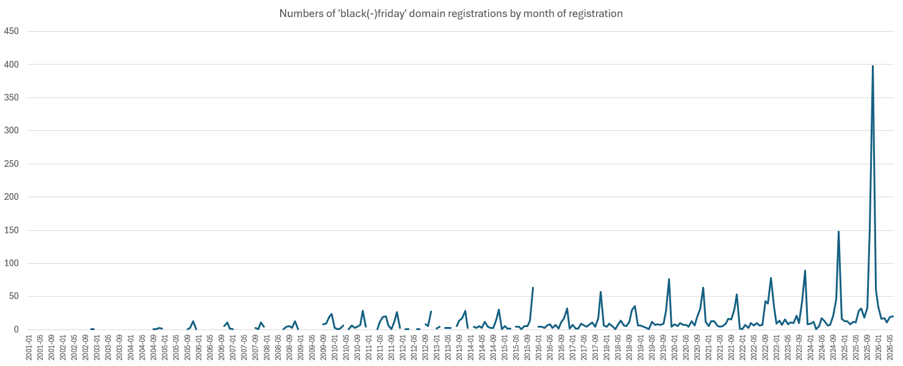
Figure 1: Numbers of registered gTLD domains with names containing black(-)friday’, by original month of registration (from 2001 to 2026).
Approximately 300 appear to be legitimate registrations by brand owners, based on the use of corporate domain registrars. That leaves around 3,800 domains that warrant potential interest or concern.
And this is before the traditional Black Friday build-up hasn’t even begun yet.
The registration data shows a striking annual pattern: activity consistently peaks during Q4, around the Black Friday period. There is also evidence suggesting that overall activity may be increasing over time, although this needs to be treated with some caution because the current analysis only captures domains that remain registered today. Short-lived domains that were registered for a single shopping season and subsequently allowed to lapse are therefore excluded.
In other words, the 4,100 figure is not the full historical picture. It is the existing landscape that remains visible today.
The biggest risk may not have your brand name in the domain. One of the most interesting findings from the research is what these domains don’t contain.
Only nine domains in the dataset — 0.2% — include the name of one of the top ten global luxury brands. A further 22 — 0.6% — feature the name of one of the top ten global retail brands.
At first glance, that might sound reassuring.
It isn’t.
It tells us something important about how bad actors can use Black Friday domains.
Rather than registering domains containing a specific brand name, they can use generic, commercially attractive terminology that creates the appearance of a legitimate Black Friday shopping destination.
For example:
- “shop”
- “sale”
- “outlet”
- “deals”
- “vouchers”
- “coupons”
- “giftcards”
Put alongside product categories such as clothing, watches or tablets, or country-specific terms, these domains can then potentially be used to target individual brands, multiple brands, or entirely different products and services.
Why does that matter?
If you are utilising a brand protection strategy based purely on exact brand-name matching, or even mis-spelt brand names, it could well miss these threats entirely.
A domain doesn’t need to say your brand’s name to create a problem for your brand. Plus, more than half of these domains are already live.
The scale becomes even more significant when we look at what these domains are actually doing. Of the approximately 3,800 domains we discovered and felt were of potential interest or concern:
1,934 — 50.9% — return a live website response.
That means there is already some form of active content associated with more than half of the domains.
And the content is not limited to obvious Black Friday ecommerce sites.
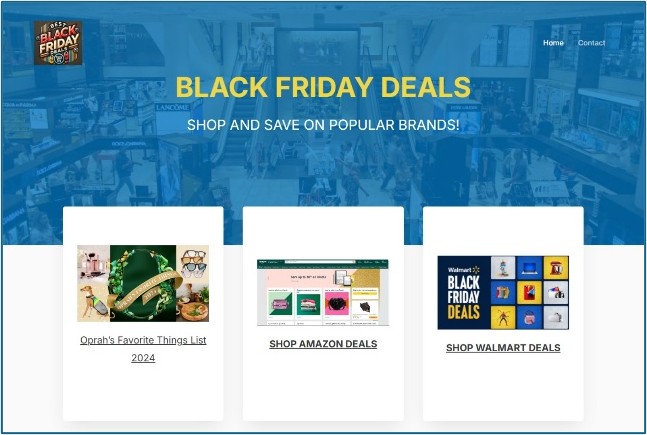
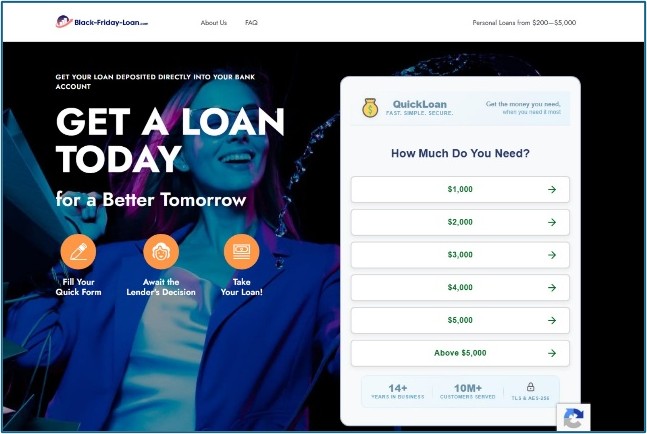
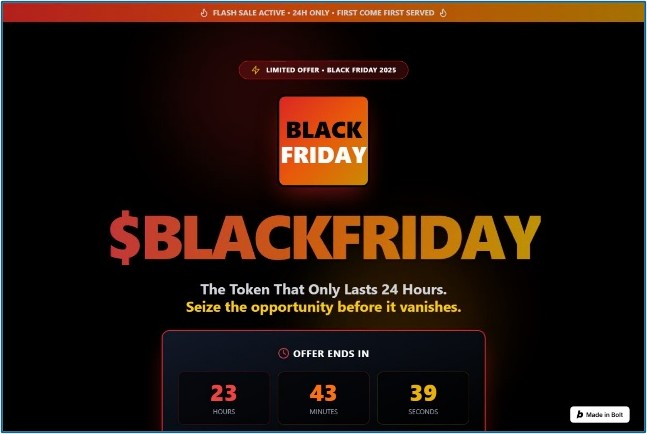
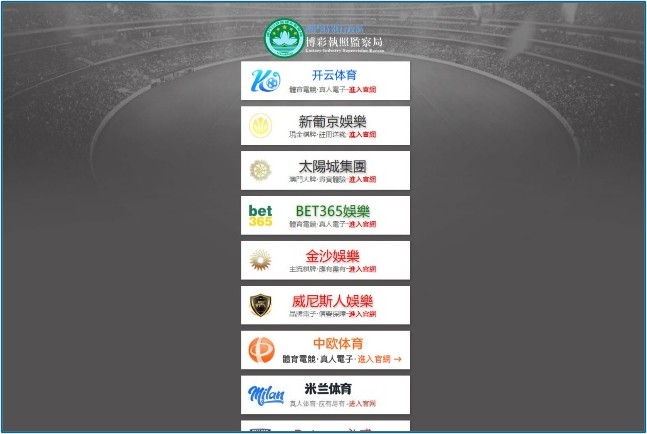
The analysis identified websites promoting sales across multiple brands and platforms, alongside sites associated with other products and services, including payday loans, cryptocurrency and gambling.
This is an important reminder that a Black Friday domain is not automatically a counterfeit site — but neither should it automatically be dismissed as harmless.
Context matters.
The threat doesn't stop at a website
There is another finding from our research that deserves particular attention.
1,415 domains — 37.2% of the total — have active MX records.
In simple terms, these domains have been configured to send and receive email. Even where there is no live website, that capability could potentially be associated with active email or phishing campaigns. For brand owners, this broadens the risk considerably.
The threat is not necessarily just:
“Could someone use this domain to sell counterfeit products?”
It can also be:
“Could someone use this domain to make consumers believe an email, promotion or communication is connected to a legitimate Black Friday offer?”
That makes domain monitoring relevant not only to brand and ecommerce teams, but potentially to security, digital and marketing teams too.
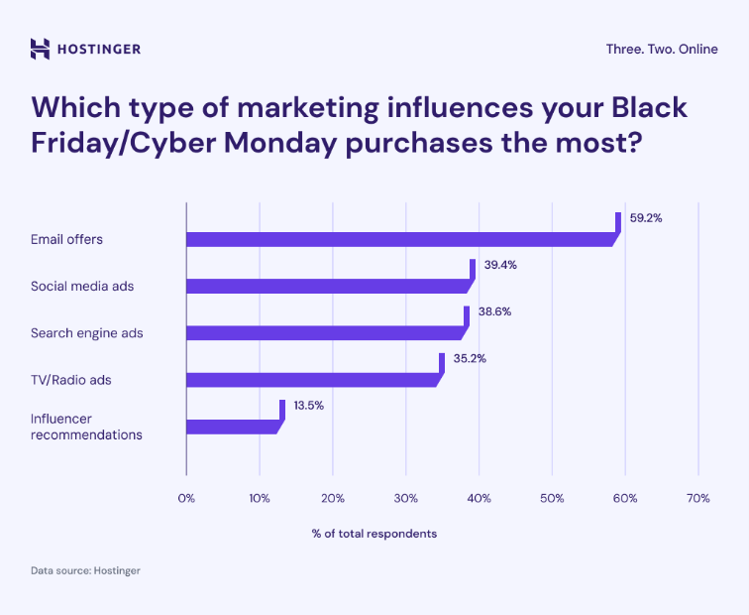
It is also a reflection of what consumers reported in the 2024 research study by Hostinger where 59.2% of respondents said that email offers were the top method of marketing that influenced their Black Friday and Cyber Monday purchases.
Not all domain extensions carry the same level of risk
The discovered domains span a wide range of Top Level Domains (TLDs).
The ten most represented in the dataset are:
- .com — 2,738
- .shop — 171
- .net — 137
- .info — 102
- .org — 98
- .xyz — 54
- .world — 36
- .sbs — 34
- .click — 30
- .store — 26
Some of these numbers are unsurprising. For example, .com and .net, are widely used generally, while .shop and .store have an obvious ecommerce relevance.
Others are more noteworthy.
Several newer gTLDs — including .xyz, .world, .sbs and .click — have previously been associated disproportionately with infringing activity.
This doesn’t mean that every domain using one of these extensions is malicious. It does mean that TLD can be one useful signal when assessing risk.
The real lesson: don’t wait for Black Friday
The most important finding from this research may actually be the simplest.
The Black Friday threat is not seasonal.
Yes, registration activity follows a strong annual cycle, with significant peaks in Q4.
But the existence of around 4,100 Black Friday-related domains in June — months before the main shopping period — demonstrates that the digital landscape is already established before consumers start searching for deals.
And as the year progresses, the number of registrations is likely to increase.
Waiting until November to start monitoring therefore means starting long after the activity has already begun.
What should brands do now?
The research points towards a few practical actions.
- Start monitoring before your Black Friday campaign starts
Don’t make Black Friday monitoring a two-week exercise. Establish a baseline early, identify suspicious domains and track how the landscape changes as Q4 approaches.
That gives you something much more valuable than a snapshot: a picture of how the threat is developing.
- Don’t search only for your brand name
Generic domains are a significant part of the landscape. Your monitoring strategy should therefore consider combinations of:
brand + Black Friday + ecommerce terminology + product terminology + relevant markets
rather than relying solely on exact brand-name matches.
- Look beyond the website
A domain is only one part of a wider digital ecosystem. The research itself highlights how ecommerce activity is increasingly interconnected with short-form video and messaging apps and email capability.
That means a suspicious domain could be just one component of a broader campaign. Monitoring should therefore connect the dots between domains, websites, email, marketplaces, social content and other relevant channels on an ongoing basis.
- Prioritise rather than simply collect data
Thousands of domains can quickly become an overwhelming dataset. The objective shouldn’t be to investigate every suspicious domain equally.
Instead, look for signals such as:
- Is there a live website?
- Is ecommerce activity taking place?
- Is the brand being referenced?
- Are products being offered?
- Is there active email functionality?
- Does the domain connect to other suspicious activity?
- Is the site targeting a particular market?
- Is there evidence of phishing or consumer deception?
The goal is not more alerts. It’s better intelligence. To dive deeper into this you can download our Black Friday Guide.
- Make Black Friday a cross-functional exercise
Brand protection shouldn’t sit in isolation during high-risk periods. The findings from this research point towards the need for collaboration between marketing, legal, digital and security teams.
- Marketing knows what legitimate campaigns are planned.
- Ecommerce knows where consumers are expected to shop.
- Legal understands the available enforcement options.
- Security can help assess phishing and other technical risks.
Bringing these perspectives together can make it much easier to distinguish legitimate promotional activity from activity that threatens the brand or its customers.
The question isn’t “What happens on Black Friday?”
It’s “What is already happening before Black Friday?”
Thousands of Black Friday-related domains already exist. More than half of those of potential concern have live websites. More than a third have active email functionality. And many of the domains are generic rather than explicitly tied to a particular brand.
That combination makes one thing clear:
Brands cannot afford to treat Black Friday brand protection as a short-term campaign. The strongest approach is proactive, continuous and connected across channels.
Start by identifying the domains, websites and wider digital activity already associated with the event. Establish your baseline. Identify the highest-risk activity. And put an enforcement plan in place before consumer attention reaches its peak.
When millions of consumers are searching for the best deal, the last thing you want is for someone else to control where they end up.
Figure 2: Examples of live websites associated with Black Friday domains
Want to see how SnapDragon’s AI can protect your brand?
If you would like to explore how SnapDragon can accelerate your online brand protection, safeguarding all your valuable brand assets, get in touch to schedule a demo.
We would love to hear from you, show you what’s possible, and get you protected.
Get in touch today.