

A standardised set of terminological descriptions is essential in many areas of brand protection, providing clarity in product and service descriptions, and allowing consistency in reporting and communications.
This latest instalment of my blog gives an overview of an updated framework of definitions to be used in describing the path of a result through the enforcement process. It makes use of two key concepts: ‘statuses’, which describe the current point of the result within a dynamic workflow, and ‘actions’, which reflect fixed points within the timeline at which significant status changes occur.
“In my ‘Brand Protection Notebook’ blog series, I’ll be aiming to provide an overview of projects, tasks, events and insights associated with my role in leading the Brand Protection team here at SnapDragon” David Barnett
One initiative to be addressed in my first weeks at SnapDragon was a project to standardise the terminology used in our brand protection workflows, working in conjunction with our Legal IP Engineer, Analyst, Technology and Commercial teams.
Consistent use of language has multiple benefits, including clarity in inter-team and provider/client communications, transparency of concept descriptions across workflows, reporting and technology, and better understanding of products and services within the provider market generally.
Aligning Terms with the Industry
Some of the proposed changes are simple modifications, to align with the terms most commonly used in the industry generally (such as ‘result’ to refer to any arbitrary finding from a brand monitoring service, as distinct from ‘listing’, which is more usually used to refer to a marketplace result specifically), or are adjustments towards usage which is more formally aligned with standard industry definitions (such as the use of the term ‘scraping’ to refer to the process of extracting of features directly from a webpage (or similar), rather than as a term referring more generally to the collection of monitoring data).
One area where a robust definition framework is particularly useful is in the description of enforcement workflows – i.e. the end-to-end process of detecting and reviewing results, carrying out takedown actions, and then tracking the result through to the completion of the cycle. During this process, the result passes through a number of intermediate statuses; accurate description and tracking of these is key to effective reporting, reflecting the current state-of-play in the brand protection portal, and determining timelines for the transitions from one part of the workflow to another.
The New Framework
The suggested description framework is based largely on the pre-existing descriptors, though also with some modifications (such as the use of the more general term ‘enforced’ to refer to the status of a takedown having been actioned, rather than the previous ‘submitted’, which could be taken to imply a specific type of enforcement involving the input of information – say, into a webform).
Of particular importance in this reconfiguration of the terminology is the use of two main concepts: status refers to the current point at which a given result exists in a dynamic workflow; whereas action refers to a specific workflow step taken on (or status change applied to) a result at a specific time – the ‘action’ times for a particular result occur at points in its workflow timeline which are permanently fixed.
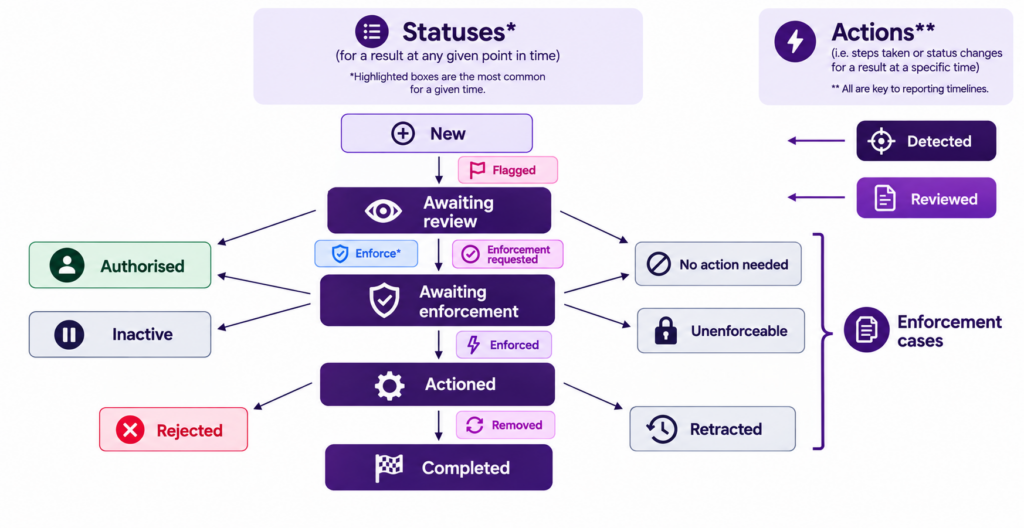
A schematic representation of the suggested pieces of terminology to describe the statuses and actions relating to a particular result within its enforcement timeline.
The use of a well-defined terminological framework of this type makes it possible to track the progress of each result through its enforcement cycle, and provides consistency between the way in which results are tracked in the portal, and how statistics can be presented in dashboards and summary reports.
Both of the high-level concepts (‘statuses’ and ‘actions’) are valuable in reporting, and provide different insights; analysis of statuses provides a current snapshot of the results in the system to determine whether, (for example), if there are results still to be reviewed by the client, or enforcements which have been submitted but have not yet been resolved, whereas analysis of actions provides an overview of the activity having taken place within a given reporting period.

David Barnett
SnapDragon | Director of Brand Protection
Want to see how SnapDragon’s AI-powered Tech can protect your brand?
If you would like to explore how SnapDragon can accelerate your online brand protection, get in touch to schedule a demo.
We would love to hear from you, and show you what’s possible.
Get in touch today.