

AI functionality is a key component of SnapDragon’s brand protection technology platform, used to prioritise and categorise results for further analysis. Dealing with the large volumes of results collected via monitoring can be a major operational challenge, and therefore a robust process for identifying the highest-threat findings is essential for building efficiency into the analysis process.
As part of the process of gaining familiarity with the functionality of SnapDragon’s proprietary brand protection management platform, I took a deep dive into the ways in which AI is currently being utilised within the technology. This was achieved through conversations with key stakeholders in the Analyst and Technology teams.
“In my ‘Brand Protection Notebook’ blog series, I’ll be aiming to provide an overview of projects, tasks, events and insights associated with my role in leading the Brand Protection team here at SnapDragon” David Barnett
One key requirement in any brand protection analysis tool is the ability to score and prioritise the raw results identified through monitoring. This process is key to identifying the highest-priority examples for initial inspection and further analysis, from within a dataset of what might be several thousands (at least!) of findings.
In SnapDragon’s technology, AI is employed in a number of ways, with each analysis type generating its own score ‘component’. These components can be used for prioritisation either individually or in combination, depending on the types of content being considered. The individual AI scores can be viewed in the portal from within the ‘listing details’ view for any given result (and can of course also be used as a basis for sorting the sets of results overall).
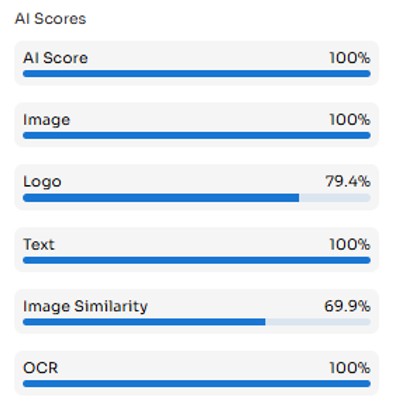
The individual AI score components for a result analysed within the brand protection platform.
The various individual AI scores calculated in the system can be summarised as follows:
- Image similarity – This is the simplest component to understand, and measures just the (highest) degree of similarity between an image in the result (e.g. a product image in a marketplace listing) and an official image provided by the brand owner, as used for ‘training’ the AI system
- Logo – Here it measures the degree of similarity between a logo found on the webpage and the official logo for the brand in question. The accuracy is dependent on factors such as the size and quality of the logo on the page, but a score of less than 80% generally indicates that the logo is not present (and that the specific best-fit match is likely to be a ‘false positive’).
- OCR – The score in this case is based on an automated analysis of text within images (‘Optical Character Recognition’), looking for the appearance of specified key-terms. In this case, the quality of the match can be affected by the use of non-standard or distorted fonts.
Developing AI-based Predictable Scoring
The above types of AI-based analysis can all be implemented ‘out of the box’. However, the technology also has the capability to use machine learning to quantify the likelihood of infringement, based on comparison with other previously reviewed results which have been marked as either infringing or irrelevant. This approach can be applied either to text or image analysis, giving rise to the two correspondingly named score components. In these cases, the accuracy of the scoring will improve as the number of training cases increases, and is generally most effective after the review of approximately the first 1,000 results.
Based on the components described previously, the term described simply as ‘AI Score’ comprises a weighted combination of the image and text scores. Future work is planned to develop more comprehensive scoring systems, taking account of all of the individual components more fully, to provide more robust measures of potential result relevance. This type of work will help to take account of the fact that multiple attributes of any given result can be relevant to an assignment of the likely level of threat.
Going forward, we are also exploring the implementation of other scoring systems, including the use of components which are more deterministic in nature. This offers the potential for a more robust and repeatable approach, and can potentially take account of characteristics such as the presence and prominence of relevant keywords on the page, other features such as the form and structure of the page URL, or of domain ownership or configuration attributes.

David Barnett
SnapDragon | Director of Brand Protection
Want to see how SnapDragon’s AI-powered Tech can protect your brand?
If you would like to explore how SnapDragon can accelerate your online brand protection, get in touch to schedule a demo.
We would love to hear from you, and show you what’s possible.
Get in touch today.